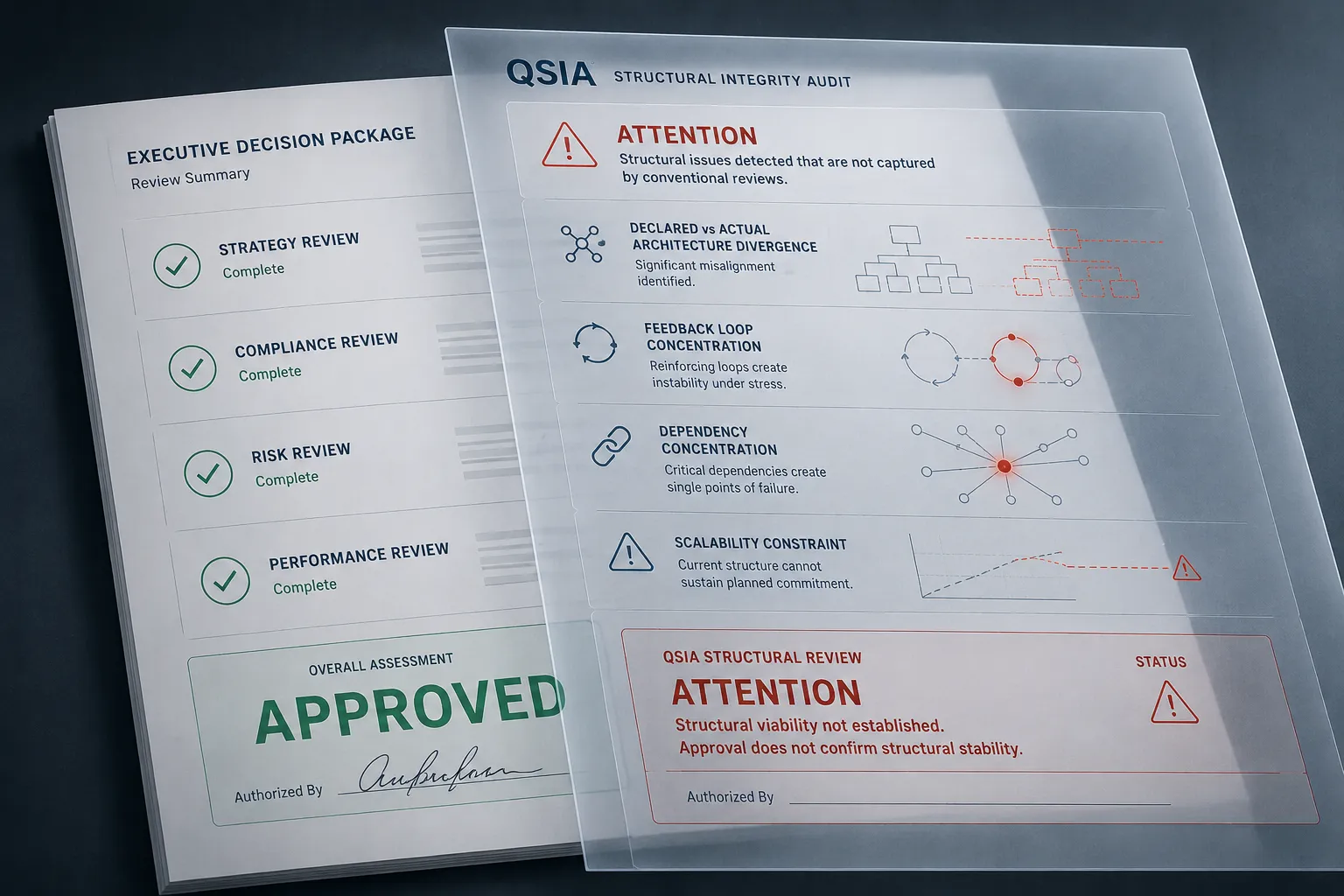
They cut across industries and roles. What each shares is a moment when conventional review
confirms the surface, and the risk sits in the architecture underneath.
Post-Acquisition Integration
The deal closed and the org charts merged. What rarely merges on schedule is the
architecture underneath: incompatible systems, inherited dependencies, and quality
cultures that never truly fused. Integration is where acquired fragility enters the
parent unseen.
Platform Scaling or Market Expansion
What held at the last size is starting to slip. Growth does not just add load, it
changes the structural requirements, and a design built for an earlier scale can pass
every metric while quietly losing the conditions that let it hold.
Pattern Failures Across Divisions
The same kind of failure keeps surfacing in different parts of the organization, with no
single owner and no shared cause. When a pattern repeats across units that do not talk to
each other, the root is not local. It is structural, and it recurs until the architecture
is addressed.
Governance Complexity Exceeding Oversight
The organization has outgrown the systems meant to watch it. Boards and leadership review
what is reported, while the real operating structure has run past what any committee or
dashboard can actually see. Oversight stays intact on paper as the system runs unwatched.
Pre-Deal Structural Diligence
Before you acquire, invest, or commit, diligence confirms the financials, the legals, and
the model. None of it tests whether the target can structurally sustain what you are
paying for. A clean diligence file and a fragile architecture look identical until after
the deal.
Leadership Senses Drift It Cannot Localize
Outcomes are drifting from intent, and you feel it before you can point to it. The
reports come back clean, the metrics are in range, and the unease will not leave. That
instinct is usually structural pattern recognition arriving ahead of the evidence.